


 Know-how Information on Holding Magnets

| 1.1 | "Open" disc or rod magnet Factor 1 |
 |
 |
||
| 1.2 | With iron backing plate Factor 1.3 |
 |
|
||
| 1.3 | With iron backing plate plus central pole Factor 4.5 |
 |
|
||
| 1.4 | Disc magnet in iron pot (disc-type holding magnet) Factor 6 |
 |
|
||
| 1.5 | Ring magnet in iron pot with additional central pole. Factor 6 |
 |
|
||
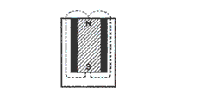
| 1.6 | AINiCo rod magnet in iron sleeve (Deep pot holding magnet, pot magnets) Factor 7.5 |
 |
|
||
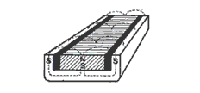
| 1.7 | U-shaped magnetic rail Factor 5.5 |
 |
|
||
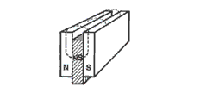
| 1.8 | Magnet block between 2 flat iron strips (sandwich system) Factor 18 |
 |
|
||
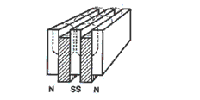
| 1.9 | Battery of sandwich systems (Types L50 . . . L200) Factor 18 x number of systems |
 |
|
||
| 2. | Two magnet blocks with opposing poles on iron backing plate, for achieving a wide-reaching, concentrated magnetic field, as required for catching magnets. | 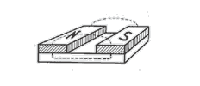 |
|
||
| 3. | Multiple pole magnetisation on the holding surface of magnetic foils and strips enables a high density of flux lines over the magnetic surface. This magnetisation is particularly suitable for application to thin iron sheets. | 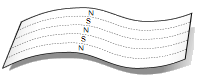 |
|
||
| 4. | The holding force depends on the smoothness of the surface = remaining holding force | 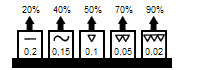 |
|
||
| 5. | The holding force depends on the material of the holding surface. | 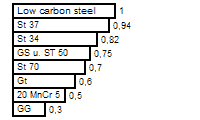 |
|
||
| 6. | Ratio of shifting force to holding force. | 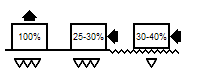 |
|
||
| 7. | A "magnetic" short-circuit is caused when both poles are bridged by iron. Connections should therefore be made from unmagnetised materials, e.g. brass, stainless steel. | 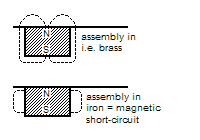 |